
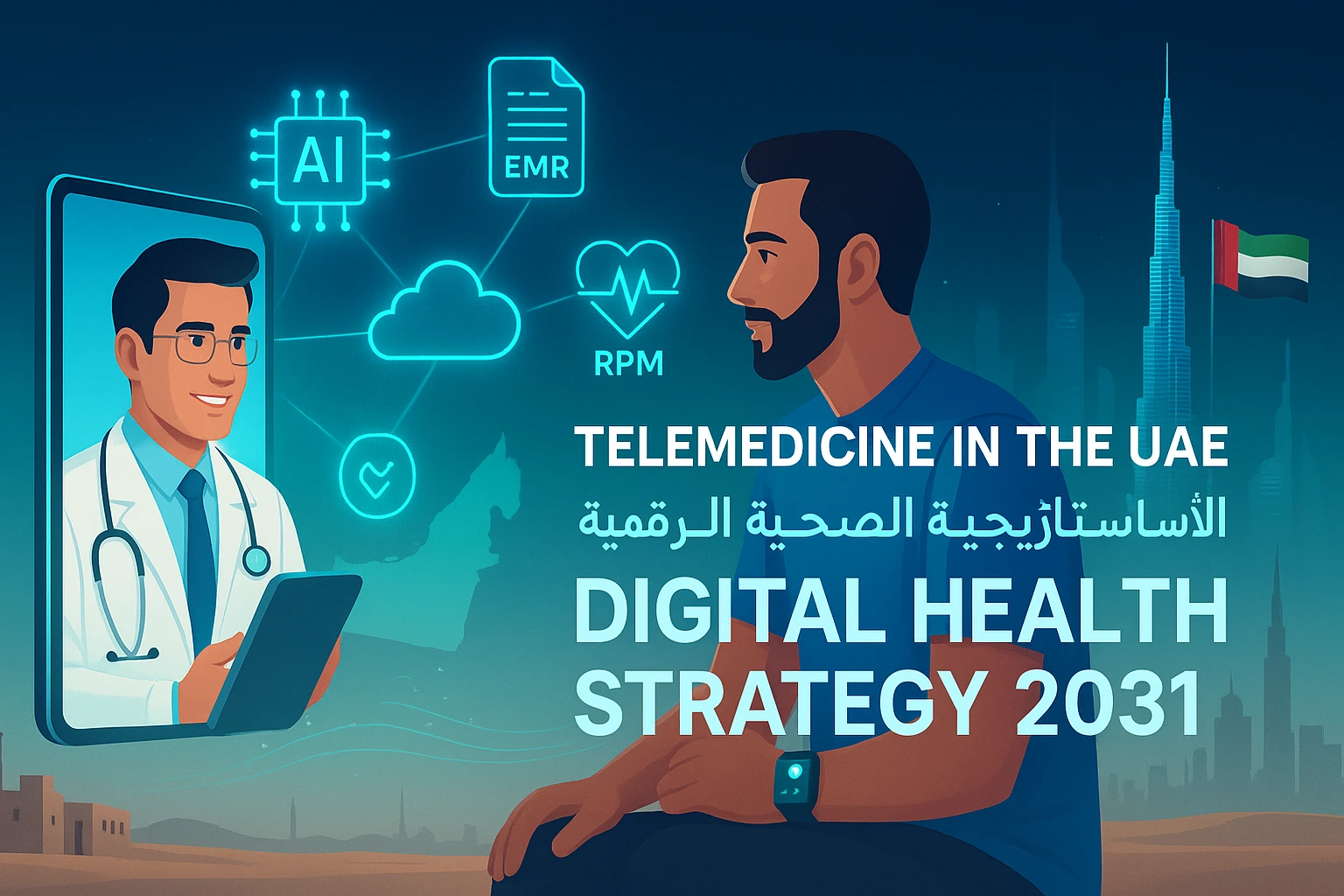
Telemedicine in the UAE is revolutionizing healthcare delivery, powered by state-backed digital innovation, forward-looking regulations, and scalable virtual care models. Patients can now book online doctor consultations in Dubai, Abu Dhabi, and across all Emirates through licensed telehealth platforms—making healthcare more accessible, efficient, and patient-centric.
Flagship programs like Doctor for Every Citizen (DEC), launched by the Dubai Health Authority (DHA), exemplify how the country is bringing medical care to residents’ fingertips. Whether it’s managing chronic conditions, scheduling follow-up appointments, or accessing 24/7 virtual clinics, the UAE’s telemedicine services are helping reduce wait times and improve continuity of care.
This transformation is governed by comprehensive legal frameworks such as Federal Law No. 2 of 2019 and the ICT Health Law, which enforce strict compliance on medical data privacy, cross-border licensing, and service quality standards. Platforms also adhere to ADHICS (Abu Dhabi Healthcare Information and Cyber Security Standard), ensuring data protection and cybersecurity for patients.
On the innovation front, the UAE integrates cutting-edge technologies, including AI-powered diagnostics, IoT-enabled medical devices, and cloud-based EMR systems. Regulatory sandboxes like UAE RegLab foster experimentation and compliance for emerging medtech startups. Notably, pilot programs using drone-assisted medication delivery and smart hospital infrastructure are already active, aligning with GCC-wide interoperability goals and the nation’s UAE Vision 2031.
As smart clinics, digital-first healthcare startups, and national health portals expand, telemedicine is becoming the default mode of healthcare access in the UAE. This positions the country as a regional leader in digital health governance—blending accessibility, innovation, and patient safety into one strategic model.
This guide will walk you through how telehealth works in the UAE, which platforms are trusted, and why it’s rapidly becoming the preferred choice for healthcare access.
Current State of Telemedicine in UAE

Telemedicine—the remote diagnosis, treatment, and monitoring of patients via telecommunications technology—has rapidly become a core pillar of healthcare innovation in the UAE. This shift is fueled by strategic public and private investments, rising consumer demand for digital health services, and bold government-led digitization initiatives.
According to a 2023 report by Mordor Intelligence, the UAE telemedicine market was valued at USD 425.46 million, with projections estimating growth to USD 1.2 billion by 2029, reflecting a compound annual growth rate (CAGR) of 19.25%. These figures underscore the UAE’s accelerating transition toward a digital-first healthcare ecosystem.
| Year | Market Value (USD) | CAGR | Source |
|---|---|---|---|
| 2023 | $425.46 million | — | Mordor Intelligence |
| 2029 | $1.2 billion | 19.25% | Mordor Intelligence |
This growth trajectory is enabled by both macroeconomic stability and structural healthcare reform. With over 99% internet penetration (World Bank, 2022), high mobile adoption, and a digitally literate population, the UAE provides fertile ground for scalable telehealth solutions. Key telemedicine service verticals include:
- Teleconsultations
- Remote patient monitoring
- Teleradiology
- AI-assisted triage and diagnostics
- Virtual chronic care platforms
Healthcare leaders note that while COVID-19 catalyzed the initial surge in virtual care, the long-term sustainability of telemedicine now hinges on its integration into population health strategies, care coordination models, and chronic disease management workflows.
Operational Impact and Platform Performance
Efficiency and impact in this sector are measured by KPIs such as:
- Reduced patient wait times
- Improved provider-to-patient ratios
- Lower hospital readmission rates
Popular UAE-based platforms like Shefaa, Okadoc, and Altibbi have reported consistent improvements across these metrics. Their success is bolstered by user-friendly mobile apps, real-time scheduling, and multilingual functionality—including Arabic-language consultations—to ensure equitable digital healthcare access across the UAE’s diverse population, including non-Arabic-speaking expats.
Regulatory Landscape and Digital Health Governance
The expansion of telemedicine in the UAE is supported by a robust regulatory framework aimed at ensuring data privacy, clinical safety, and interoperability. Key regulations include:
- Federal Law No. 2 of 2019 – Governing the use of ICT in health fields
- ICT Health Law – Establishes rules for telehealth services and cross-border licensing
- Federal Law No. 4 of 2015 on Medical Liability – Covers malpractice and accountability
- Cabinet Decision No. 40 of 2019 – Sets national telemedicine guidelines
Oversight is provided by:
- Ministry of Health and Prevention (MoHAP)
- Dubai Health Authority (DHA)
- Department of Health – Abu Dhabi (DoH)
- Compliance is also maintained through international health data standards like:
- ADHICS (Abu Dhabi Healthcare Information and Cyber Security Standard)
- SNOMED CT
- HL7
To support innovation within this regulatory framework, healthcare providers and startups are encouraged to:
- Conduct routine audits of telehealth outcomes and workflow efficiency
- Adopt AI-enabled clinical decision support tools
- Transition to cloud-native, ADHICS-compliant EHR systems
- Participate in sandbox testing via UAE RegLab for emerging digital health technologies
These collective efforts have positioned the UAE as a regional benchmark for digital health governance, with the World Health Organization (WHO) citing its approach as a model for telemedicine policy and innovation across the MENA region.
Key Players in the UAE Telemedicine Market

The UAE’s telemedicine landscape is shaped by a dynamic mix of public institutions, private healthcare systems, digital-first innovators, and international health tech platforms. These entities play a vital role in expanding virtual healthcare services, improving patient accessibility, and supporting national strategies like UAE Vision 2031, the National Digital Health Strategy, and the Dubai Health Strategy 2021.
Outlined below is a categorized overview of the leading telemedicine providers across the UAE, detailing their service offerings, regulatory adherence, and contributions to the digital health ecosystem.
| Platform | Type | Key Features | Regulator | Integration |
|---|---|---|---|---|
| SEHA | Government | Virtual outpatient, AI triage | DoH | Riayati |
| Okadoc | Private/Marketplace | Smart scheduling, real-time consults | DHA | Multiple |
| vHealth | Private (Aetna) | 24/7 access, insurance tie-in | DHA | Mediclinic |
| HealthHub | Private | Cloud EHR, at-home diagnostics | DHA | NABIDH |
| InstaDoctor | Private/Startup | Mental health, multilingual, pharmacy links | DHA | Yes |
Government and Public Sector Providers
SEHA (Abu Dhabi Health Services Company): Operates under the Department of Health – Abu Dhabi (DoH)
- Recognized as the UAE’s largest integrated healthcare network, offering AI-enhanced telemedicine, virtual outpatient consultations, and long-term condition management
- Fully aligned with ADHICS standards and seamlessly connected to Riayati, the national Health Information Exchange (HIE)
- Provides services across more than 30 medical specialties, promoting continuity of care throughout the Emirate
Mubadala Health: A state-supported healthcare group delivering telehealth via institutions such as Cleveland Clinic Abu Dhabi, Healthpoint, and Imperial College London Diabetes Centre
- Emphasizes AI-based diagnostics, telemonitoring, and remote expert consultations
- Contributes to Abu Dhabi Vision 2030 by advancing chronic care models and integrating wearable technology
Private Healthcare Providers
HealthHub by Al-Futtaim: A blended care model operated by the Al-Futtaim Group and accredited by the Dubai Health Authority (DHA)
- Offers remote consultations, at-home diagnostic services, and personalized preventive health coaching
- Utilizes cloud-based EHR systems compatible with NABIDH, Dubai’s centralized health data exchange
- Facilitates scalable primary care delivery aligned with the objectives of the Dubai Health Strategy 2021
Digital Health Startups & Platforms
Health at Hand: A DHA-licensed telehealth startup delivering on-demand video consultations
- Operates across B2C and B2B2E segments, integrated within corporate wellness frameworks
- Enables real-time e-prescriptions, appointment management, and comprehensive medical history tracking
- Collaborates with insurers like Cigna and AXA Gulf to broaden service affordability
Okadoc: A comprehensive telehealth marketplace and scheduling platform linked to networks including Mediclinic and Emirates Hospitals
- Provides real-time appointment booking, AI-assisted triage, and intelligent waitlisting
- Adheres to HIPAA and DHA standards while advancing national patient engagement goals
InstaDoctor: A mobile-first platform licensed by DHA, specializing in multilingual teleconsultations, mental wellness services, and pediatric care
- Integrates e-prescriptions, diagnostic lab coordination, and virtual pharmacy solutions for holistic digital care
- Prioritizes accessible healthcare for underserved demographics and expatriate communities
Trydoc 24×7: Accredited by both DHA and MoHAP, Trydoc offers around-the-clock digital urgent care through AI-enhanced chat and video interactions
- Includes features such as virtual queuing, digital wallet compatibility, and pharmacy integration
- Geared toward mobile users seeking quick, AI-guided access to healthcare
Technology Infrastructure & Enterprise Platforms
vHealth (Aetna International): Delivers remote diagnostics, specialist consultations, and wellness services tailored for the expatriate demographic
- Partners with major players like Mediclinic Middle East and Bupa Global
- Offers multilingual support and AI-driven clinical decision-making tools
- Designed to promote value-based care while minimizing unnecessary hospital admissions
VSee: Originally engineered for NASA, now a foundational telehealth infrastructure provider within the UAE
- Supplies customizable platforms with EHR integration and HIPAA-compliant APIs
- Fully compatible with HL7 and FHIR, facilitating nationwide interoperability and data standardization
NextGen Healthcare: A robust provider of enterprise-level EHR and telemedicine solutions
- Offers tools for predictive analytics, chronic disease surveillance, and coordinated virtual care
- Holds certifications including ONC-ACB and ISO 27001, and aligns with MoHAP’s digital transformation benchmarks
Summary
The UAE’s foremost telemedicine providers are transforming the digital healthcare frontier by:
- Maintaining rigorous compliance with DHA, MoHAP, DoH, and global health IT standards
- Leveraging AI-driven care delivery, interoperable platforms, and cloud-native infrastructures
- Expanding inclusive, multilingual, and mobile-optimized access to healthcare
Together, these pioneering organizations are propelling the UAE to the forefront of global telehealth innovation, in synergy with UAE Vision 2031 and broader GCC digital health strategies.
In addition to platform-based teleconsultations, HealthFinder.ae serves as a central healthcare directory, enabling users across the UAE to find licensed clinics, hospitals, and remote-ready providers offering telemedicine services.
Technological Advancements Driving Telemedicine in the UAE

The UAE’s telemedicine evolution is underpinned by advanced technologies that elevate diagnostic precision, streamline healthcare operations, and enhance patient-centric outcomes. These transformative tools are closely aligned with national strategies such as the UAE National Artificial Intelligence Strategy 2031 and digital frameworks set forth by the Ministry of Health and Prevention (MoHAP)—cementing the nation’s role as a regional and international frontrunner in smart healthcare innovation.
| Technology | Use Case | Platform Example | Regulatory Alignment |
|---|---|---|---|
| AI Diagnostics | Triage, predictive health | SEHA, NABIDH | Federal Law No. 2 of 2019 |
| RPM Devices | Chronic care management | Trydoc 24×7, vHealth | ADHICS, SNOMED CT |
| EMRs + Cloud | Secure data exchange | HealthHub, NextGen | NABIDH, HL7, FHIR |
| Telepresence Bots | Remote rounds, isolation wards | Cleveland Clinic Abu Dhabi | DoH, MoHAP AI guidelines |
Integration of AI and Robotics in Telemedicine
Artificial Intelligence (AI) and robotics are revolutionizing healthcare delivery in the UAE, reshaping core services including diagnostics, triage, and remote clinical interaction.
Key Innovations:
- AI diagnostics: Enables real-time analytics, predictive risk modeling, and tailored treatment recommendations
- Robotic assistants: Deployed in ICU and isolation units to facilitate remote consultations and minimize infection risks
- Multilingual AI: NLP systems optimized for Arabic healthcare interactions, developed by MBZUAI and the UAE AI Lab
Real-World Applications:
- SEHA’s Virtual Clinics utilize machine learning to identify high-risk patients and recommend personalized care pathways
- DHA integrates predictive AI within NABIDH to proactively manage chronic disease populations
- Cleveland Clinic Abu Dhabi employs telepresence robots during rounds, enhancing continuity while safeguarding against exposure
Compliance & Governance:
- Regulated under Federal Law No. 2 of 2019 addressing AI in healthcare
- Emphasizes algorithmic transparency, ethical AI practices, and robust patient safety standards
Remote Patient Monitoring (RPM) Technologies
Remote Patient Monitoring (RPM) empowers continuous care by leveraging connected health devices to track clinical parameters in real time—facilitating personalized and anticipatory treatment approaches.
Key Features:
- Wearable tech: FDA-cleared ECGs, blood pressure monitors, glucometers, and pulse oximeters enable real-time biometric tracking
- Home-based care: Optimized for managing long-term conditions such as COPD, cardiovascular diseases, and diabetes
- Data integration: Synchronizes with cloud-native EMRs compliant with ADHICS and SNOMED CT for clinical accuracy and data interoperability
Leading Initiatives:
- Malaffi’s RPM pilot in Abu Dhabi uses AI dashboards to detect anomalies, triggering early clinical interventions
- HealthHub, vHealth, and Trydoc 24×7 have embedded RPM tools into chronic care management frameworks
- Digital Health Passport—a collaboration between MoHAP, Etisalat Health, and Oracle Cloud—consolidates wearable data into national health records
Regulatory Oversight:
Governed by Cabinet Resolution No. 40 of 2019
-
Requires adherence to UAE Telehealth Licensing Guidelines, including:
- Use of certified medical-grade devices
- Encrypted data transmission protocols
- Comprehensive patient consent procedures
Strategic Impact on UAE Digital Health
By integrating AI-driven diagnostics with wearable-enabled RPM, telemedicine in the UAE is transitioning from episodic interventions to a model of sustained, proactive healthcare delivery.
System-Level Benefits:
- Accelerates the shift toward value-based care with measurable improvements in health outcomes
- Supports data-informed clinical decision-making through advanced predictive analytics
- Promotes patient empowerment via intuitive, mobile-first digital platforms
- Reinforces the UAE’s strategic pursuit of digital health excellence and maturity
These innovations—anchored in ethical frameworks and international standards—are propelling the UAE toward becoming a global exemplar of intelligent, integrated telehealth infrastructure.
Telemedicine Specialties in the UAE: Best-Aligned Disciplines for Virtual Care Delivery

Telemedicine specialties in the UAE have expanded into a robust, multi-specialty healthcare model—digitally integrated and aligned with national health priorities. Far beyond basic video consultations, today’s telemedicine offerings incorporate AI-enhanced diagnostics, remote patient monitoring (RPM), and interoperable electronic medical records (EMRs), delivered through cyber-secure, MoHAP-regulated platforms.
This expansion follows the UAE’s National Digital Health Strategy, Federal Law No. 2 of 2019, and the Telehealth Licensing Guidelines, ensuring that all virtual care specialties meet federal and emirate-level clinical, technical, and data security standards. Below are the top specialties currently best suited for telemedicine delivery in the UAE’s digital health ecosystem.
General and Preventive Medicine
As one of the most mature telemedicine specialties in the UAE, general and preventive care has broad adoption. Programs such as Doctor for Every Citizen (DHA) and MOHAP Virtual Doctor Service provide 24/7 encrypted video consultations with licensed general practitioners (GPs), integrated into the NABIDH (Dubai) and Riayati (Abu Dhabi) health information exchanges.
These services support:
- Diagnosis of common conditions (e.g., URIs, skin conditions, allergies)
- Lifestyle coaching, early risk screening, and health education
- AI-guided triage, symptom checkers, and automated e-prescription tools
All workflows comply with ADHICS security standards, ensuring full data protection and continuity of care.
Mental Health and Behavioral Services
Mental and behavioral health are among the most critical and fast-growing telemedicine specialties in the UAE. Initiatives like the MOHAP Virtual Mental Health Hub, DHA Smart Clinic, and InstaDoctor now deliver HIPAA-compliant remote access to psychiatrists and psychologists.
Key features:
- Real-time therapy via encrypted video platforms
- Digital mood tracking and sentiment analytics
- AI-driven CBT engagement monitoring, developed in part through MBZUAI partnerships
These services cater to diverse populations, including expats and rural residents, while aligning with the UAE National Policy for the Promotion of Mental Health (2019).
Chronic Disease Management
Chronic care is one of the most transformed telemedicine specialties in the UAE, especially for non-communicable diseases like diabetes, hypertension, asthma, and cardiovascular conditions.
Key platforms include:
- SEHA Virtual Clinics
- HealthHub by Al-Futtaim
- vHealth by Aetna
These leverage:
- RPM-enabled devices (glucose meters, wearable ECGs, BP monitors)
- HL7 FHIR- and SNOMED CT-compliant EMR systems
- AI analytics to track adherence, detect risks, and trigger early clinical intervention
This integrated virtual care model helps reduce hospitalizations while supporting ongoing patient engagement.
Additional Emerging Telemedicine Specialties in the UAE
To support a full spectrum of care, the UAE is also advancing telemedicine across emerging or niche disciplines:
| Specialty | Virtual Care Capabilities | Notable Platforms |
|---|---|---|
| Teledermatology | Remote skin assessments, AI-enhanced imaging | Medcare, InstaDoctor |
| Teleradiology | Image transmission and expert review across hospitals and clinics | SEHA, private radiology networks |
| Telepediatrics | Pediatric follow-ups, developmental screenings | Al Jalila Children’s Virtual Health Services |
| Teleophthalmology | Remote retinal scans and vision testing | Vision RX, private virtual eye clinics |
| Rehabilitation | Virtual physiotherapy and guided recovery programs | Cleveland Clinic Abu Dhabi – Telerehab |
By embedding telemedicine across its most vital specialties, the UAE is building a digitally resilient, patient-centered health system—one that is preventive, personalized, and powered by interoperable technology and AI-driven intelligence. The strategic alignment of telemedicine specialties in the UAE with national healthcare goals marks a global benchmark in digital health transformation.
Challenges in UAE Telemedicine: Legal, Social & Infrastructure Barriers

Despite its accelerated growth, telemedicine in the UAE faces critical structural, regulatory, and social barriers that must be addressed to ensure safe, equitable, and sustainable virtual care delivery. These challenges intersect with cybersecurity, user readiness, and digital infrastructure—foundational elements of a resilient health system. Each issue is analyzed within the context of the UAE’s National Digital Health Strategy, Telehealth Licensing Guidelines, and overarching goals under UAE Vision 2031.
Data Privacy and Security
Data privacy in telemedicine involves the secure handling of patient health information during digital transmission, storage, and access. In the UAE, this is governed by Federal Law No. 2 of 2019 on ICT in Health Fields and the Abu Dhabi Healthcare Information and Cyber Security Standard (ADHICS), both of which mandate encryption protocols, informed consent, and compliance in cloud hosting and cross-border data transfers.
Although most licensed platforms now implement end-to-end encryption, role-based access control, and tokenized authentication, emerging risks—such as ransomware, unauthorized access, and zero-day vulnerabilities—remain threats to digital health integrity. In response, MoHAP’s 2022 advisory urged providers to align with global standards like ISO/IEC 27701 and NIST cybersecurity frameworks to bolster system resilience.
“The next phase of telemedicine depends not only on innovation but on building public trust through demonstrable data protection and ethical digital governance.”
— Dr. Mohammed Al Kaabi, Cybersecurity Lead, DoH – Abu Dhabi
To strengthen public confidence, providers are advised to conduct regular penetration testing, implement multi-factor authentication, and audit third-party vendor compliance with UAE health data laws.
Digital Literacy
Digital literacy—the capacity to navigate and use digital tools effectively—remains uneven across patient and provider populations. While the UAE boasts a 99.2% internet penetration rate (World Bank, 2023), disparities in digital fluency persist among older adults, low-income expatriates, and rural residents.
National initiatives such as MoHAP’s Smart Clinics Awareness Campaign and DHA’s Digital Health Bootcamps aim to close these gaps, yet adoption rates vary. Low digital literacy can lead to misunderstood medical instructions, navigation issues within telehealth platforms, and underuse of RPM tools. On the provider side, it contributes to documentation errors, inefficient workflows, and suboptimal patient engagement.
Healthcare organizations are encouraged to:
- Implement multilingual, UX-optimized interfaces
- Provide 24/7 digital support hotlines
- Offer CPD-accredited eHealth training modules for clinical staff
Such interventions are key to enhancing usability and accessibility, ensuring telemedicine is inclusive across all social and demographic groups.
Infrastructure and Digital Access
Telehealth infrastructure refers to the digital and physical systems that support high-quality virtual care—encompassing broadband networks, device availability, and cloud infrastructure. Although the UAE ranks high in 5G readiness and ICT competitiveness, connectivity challenges persist in labor-dense areas and remote industrial zones, where network reliability remains inconsistent.
According to a 2023 TDRA report, up to 15% of users in industrial regions experience degraded connectivity, which directly impacts the quality of real-time video consultations and remote diagnostics. Smaller clinics may also lack the budget to implement HIPAA-compliant video systems, HL7/FHIR-compatible EMRs, or secure patient portals.
To address these disparities, the UAE launched the Digital Infrastructure Enhancement Program in 2022, providing subsidies for broadband upgrades and incentivizing cloud adoption through partnerships with Etisalat Health, Du Telecom, and Oracle MEA.
Strategic Outlook
Overcoming these challenges is essential to realizing a digitally mature, interoperable, and patient-centric health system. Continued investment in cybersecurity infrastructure, digital inclusion, and connectivity expansion will ensure that the UAE’s telemedicine sector remains resilient, compliant, and globally competitive.
While substantial progress has been made, bridging digital divides and reinforcing trust through robust governance will be the defining factors in sustaining the momentum of virtual care—now a cornerstone of the nation’s healthcare transformation under UAE Vision 2031.
Future of Telemedicine in the UAE: Scaling Digital Health Equity and Innovation

Telemedicine is set to evolve from a supportive service into a foundational pillar of the UAE’s healthcare system, aligning with the strategic goals outlined in UAE Vision 2031 and the National Digital Health Strategy. As the country advances its position as a global leader in smart healthcare, the growth of virtual care will be shaped by regulatory foresight, scalable digital infrastructure, and a commitment to equitable access. Two key trends define this trajectory: the formal integration of telemedicine into institutional frameworks and the deliberate extension of digital health services into underserved areas.
Sustained Growth and Health System Integration
Valued at USD 425.46 million in 2023, the UAE telemedicine market is projected to exceed USD 1.2 billion by 2029, driven by a compound annual growth rate (CAGR) of 19.25% (Mordor Intelligence, 2024). This growth is propelled by strong regulatory foundations, including Federal Law No. 2 of 2019 and MoHAP’s Telehealth Licensing Guidelines, which have enabled broad adoption across primary care, mental health, and chronic disease management.
Ongoing policy initiatives are set to deepen this integration. The potential incorporation of telemedicine into the mandatory health insurance framework—currently under evaluation by MoHAP and the Department of Health – Abu Dhabi (DoH)—is expected to significantly boost utilization rates. Simultaneously, national health information exchanges such as Riayati and NABIDH will enhance interoperability, enabling real-time care coordination between virtual and in-person providers.
Advanced technologies will further redefine the delivery of telemedicine. AI-driven diagnostics, predictive analytics, and remote surgical consults are becoming integral to future-ready healthcare models. Strategic alliances with global tech leaders—such as Philips Healthcare, Siemens Healthineers, and Oracle MEA—are facilitating cloud-native infrastructures, 5G-enabled mobile care, and scalable digital therapeutics.
Expanding Access to Rural and Underserved Populations
While 87.78% of the UAE’s population resides in urban areas (World Bank, 2023), national health equity goals require telemedicine to penetrate rural and peri-urban regions, especially in the Northern Emirates. Bridging this digital divide is essential to achieving the inclusive healthcare targets defined under UAE Vision 2031.
MoHAP’s Telehealth Access Equity Program, launched in 2022, exemplifies this effort by deploying mobile telemedicine units, satellite-linked kiosks, and trained community health workers in low-connectivity zones. These units are equipped with portable diagnostic tools, real-time vitals monitoring devices, and AI-powered decision-support systems—enabling high-quality virtual consultations in remote settings.
Infrastructure expansion is also accelerating. In collaboration with the Telecommunications and Digital Government Regulatory Authority (TDRA), telecom providers such as Etisalat and Du are extending 5G and fiber-optic networks into rural areas. This backbone is vital for the sustained delivery of high-bandwidth telemedicine services.
These developments are enabling the deployment of specialized, population-sensitive care models—ranging from maternal telehealth and elderly RPM to multilingual mental health services tailored for migrant labor populations.
A Strategic Lever for a Digitally Resilient Health Ecosystem
Telemedicine now stands as a strategic lever in the UAE’s vision for an AI-enabled, resilient, and value-based healthcare system. As the country pivots toward data-driven public health and preventive care leadership, virtual health will evolve beyond consultations to include real-time surveillance, digital therapeutics, and smart hospital integration powered by predictive modeling and cloud interoperability.
With ongoing alignment between policy, innovation, and digital infrastructure, the UAE is not only redefining access to healthcare within its borders—it is establishing a blueprint for scalable, inclusive digital health transformation across the MENA region and beyond.
Conclusion: Telemedicine in the UAE – A Blueprint for Global Digital Health Transformation
Telemedicine in the UAE has evolved from a pandemic-era contingency to a foundational pillar of the nation’s healthcare architecture—anchored in regulatory foresight, AI-driven innovation, and a commitment to equitable access. Underpinning this transformation are robust policy frameworks such as Federal Law No. 2 of 2019, MoHAP’s Telehealth Licensing Guidelines, and the forward-looking UAE Vision 2031, which collectively institutionalize virtual care across primary, chronic, and mental health domains.
The country’s digital health infrastructure is enabled by interoperable platforms—including SEHA Virtual, HealthHub by Al-Futtaim, vHealth by Aetna, and Okadoc—that combine AI-powered triage, remote patient monitoring (RPM), and standardized EMR connectivity. These platforms are designed for value-based, patient-centric care delivery, ensuring clinical quality and system-wide efficiency.
Strategic partnerships with global technology leaders, combined with nationwide 5G and fiber-optic rollouts, are enhancing scalability while reinforcing long-term sustainability. This integrated approach ensures that virtual care is not only accessible but resilient—capable of adapting to population growth, emerging health trends, and cross-border health collaboration.
While challenges persist—particularly around digital literacy, cybersecurity, and rural infrastructure—the UAE is actively addressing these gaps through targeted initiatives such as the MoHAP Telehealth Access Equity Program and TDRA-led broadband expansion in underserved regions.
Looking forward, the UAE is positioning telemedicine as the engine of an always-on, intelligent health ecosystem—enabling real-time diagnostics, AI-optimized care pathways, and the operationalization of smart hospitals. As a regional vanguard, the UAE is setting a replicable global standard for digital health transformation—demonstrating how policy alignment, technological innovation, and healthcare equity can converge to deliver future-ready, scalable care models.
Telemedicine in UAE: Your Top Questions Answered

Dr. Aisha Rahman is a board-certified internal medicine specialist with over 12 years of clinical experience in chronic disease management and preventive healthcare. She has worked at leading hospitals across the UAE, helping patients manage conditions such as diabetes, hypertension, cardiovascular diseases, and metabolic disorders.
A strong advocate for preventive medicine, Dr. Rahman emphasizes early diagnosis, lifestyle modifications, and patient education to reduce chronic illness risks. She is an active member of the Emirates Medical Association and has contributed to health awareness programs and medical research initiatives. Her expertise has been featured in The National UAE, Gulf Health Magazine, and leading medical journals. As a keynote speaker at healthcare conferences, she shares insights on evidence-based treatments, patient-centered care, and advancements in internal medicine.